
CIOReview Europe Weekly Brief
Be first to read the latest tech news, Industry Leader's Insights, and CIO interviews of medium and large enterprises exclusively from CIOReview Europe
A featured contribution from Leadership Perspectives: a curated forum reserved for leaders nominated by our subscribers and vetted by the CIOReview Advisory Board.

American Century Investments
Gen Ai Future Potential And Governance

Tarun Sood
Generative AI (GenAI) is revolutionizing tools and resources for businesses. Technologies like ChatGPT streamline workflows and bring novel business management and development approaches. This broadening of potential goes well beyond what was initially expected from AI models. According to the "Artificial Intelligence New Frontier" article by The Economist, foundation models in AI are capable of a variety of remarkable tasks. They can improve writing, create better sentences, and have human-like conversations. In music, they turn short melodies into full compositions. In software development, they quickly generate lots of computer code. They also understand humor and complex ideas. They can learn new skills independently and are versatile in various areas, like creative arts, literature, scientific research, and data analysis. Foundation models can also find new medical treatments and make sense of big datasets to create visual representations.
Gartner's GenAI Hype Cycle also offers insights into this nascent technology development and market influence. In May, Microsoft's CEO, Satya Nadella, envisioned a future where individuals of any profession could access a Copilot for all their tasks. Following this, in October, Microsoft introduced a tool specifically engineered to manage data in response to user prompts autonomously. By acting as a cobot, GenAI can bridge the gap between human intuition and machine efficiency, providing a collaborative force that enhances the capabilities of the whitecollar workforce. As a partner to human workers, GenAI can lead to more innovative, efficient, and informed workplaces.
Building upon Gartner's GenAI Hype Cycle as a strategic guide and drawing insights from other influential analyses in the field (as outlined in the reference section), we can envision a multifaceted GenAI landscape characterized by diverse technologies. The imperative for business leaders lies in seamlessly integrating these tools to complement human capabilities, ensuring technology's ethical and effective deployment to enhance the workforce. In this section, I discuss the transformative potential of GenAI and delve into the concerns surrounding risks, governance, and ethical considerations associated with GenAI models like ChatGPT.
• Autonomous Agents: These systems can operate independently in dynamic environments, making decisions and performing tasks without human intervention. They boost efficiency and effectiveness across fields like customer service, supply chain management, and personal assistance, with examples including autonomous chatbots in customer support, drones in supply chain optimization, and virtual assistants like Siri or Google Assistant.
• Reinforcement Learning: In this discipline, an agent learns decision-making by acting in an environment to maximize cumulative rewards. Reinforcement learning is crucial in developing systems that enhance their performance through experience, as seen in applications like robotics and autonomous vehicles.
• Copilots: AI copilots assist professionals in coding, email composition, and content creation by providing real-time suggestions, corrections, and enhancements. For example, GitHub Copilot can offer code snippets and suggestions during coding, leading to a streamlined development process, increased productivity, and improved code quality.
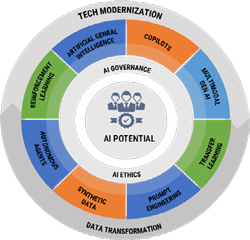 • Multimodal GenAI: This refers to AI systems capable of concurrently comprehending and generating content across various data types, including text, images, and sound. These systems enable richer interactions and comprehension, similar to how humans process information through multiple senses. An example is a chatbot that can respond to text and analyze and generate image or voice-based content as needed, offering a more comprehensive and human-like conversational experience.
• Transfer Learning: This technique reuses a model designed for one task on a related second task. It's a powerful AI method for quickly adapting and extending AI capabilities across different areas. For example, a natural language processing model initially trained for sentiment analysis on product reviews can be finetuned for sentiment analysis in social media posts, saving time and resources in developing a new model from scratch.
• Prompt Engineering: This refers to skillfully crafting input, or prompts, for AI systems to generate the desired output. It has become somewhat of an art, particularly in systems like GPT, where the prompt's quality significantly impacts the quality of the resulting output.
• Synthetic Data: This type of data is artificially generated instead of being collected through direct measurement. It's useful for training AI models when real data is scarce or privacy is a concern, leading to strong and well-trained models. For example, Synthetic data in medical imaging can expand a small set of authentic patient images, helping AI algorithms learn better while keeping patient privacy secure.
• Artificial General Intelligence (AGI): AGI represents the pinnacle of AI, denoting machines with the capacity to comprehend, learn, and intelligently address a wide range of problems akin to human capabilities. While mainly a theoretical concept, it is the ultimate aspiration for numerous AI research initiatives. When discussing GenAI, addressing its ethical aspects is paramount. Back in 1960, Norbert Wiener, a pioneer in cybernetics, expressed concerns about machines learning and making decisions beyond their original programming, drawing parallels to Goethe's "The Sorcerer's Apprentice" with its uncontrollable broom. This analogy remains relevant as AI research has advanced, raising concerns about potential risks, including the possibility of AI causing significant harm. Immediate risks are associated with large language models like ChatGPT, which can generate high-quality human-like content and be misused to spread misinformation, scams, and malware. As AI becomes more integrated into society and wields significant influence, ensuring it follows human values and doesn't unintentionally cause harm is essential. Wiener's early warnings remind us that our understanding and control of advanced technologies must keep pace with their development to avert potential disasters.
• AI Governance: This involves the rules, methods, and structures that steer the ethical creation, use, and handling of AI technologies. Ensuring AI serves humans' best interests and doesn't unintentionally cause harm is essential. For instance, AI governance might include guidelines and regulations for the fair and responsible use of facial recognition technology in public spaces to protect individual privacy and civil liberties.
• AI Ethics: This area focuses on AI's moral consequences and social effects. It encompasses concerns such as bias, fairness, transparency, accountability, and the impact on employment. For instance, AI ethics might involve establishing guidelines to minimize bias in AI algorithms for hiring decisions, ensuring a fair and equitable job market.
